When people think about orthodontic problems, they often think about appearance first. Crooked teeth, crowding, gaps, overbites, underbites, and uneven smiles can affect confidence, photos, and how someone feels about their smile. But bite problems are not only cosmetic.
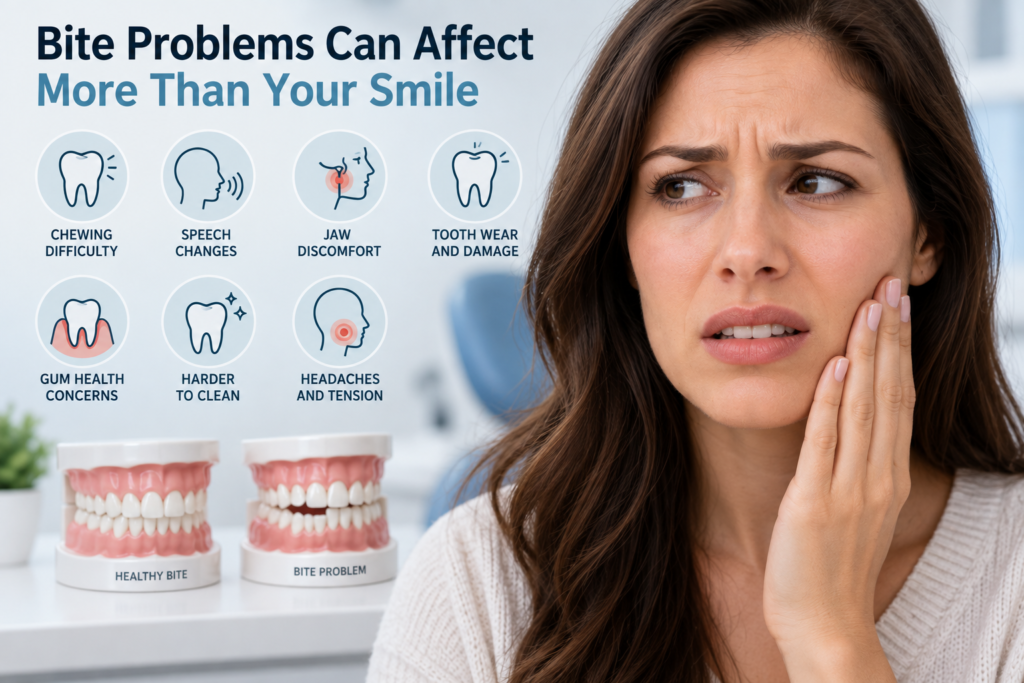
A bite problem, also called malocclusion, means the upper and lower teeth do not fit together the way they should when the mouth closes. According to MedlinePlus, malocclusion can involve overbite, underbite, crowding, alignment issues, and other differences in how the teeth and jaws meet. Depending on the type and severity, bite problems may affect chewing, speech, tooth wear, gum health, jaw comfort, and long-term oral function.
Some bite problems are mild and mostly cosmetic. Others can place extra stress on teeth, make cleaning harder, or contribute to discomfort over time. The only way to know how much a bite issue matters is to have it evaluated by a dental or orthodontic professional.
Here is how bite problems can affect more than your smile.
What Is a Bite Problem?
A bite problem happens when the teeth, jaws, or both are not aligned in a way that allows the upper and lower teeth to meet comfortably and evenly. This can include crowding, spacing, overbite, underbite, crossbite, open bite, deep bite, or teeth that are rotated or positioned irregularly.
The American Dental Association explains that orthodontic treatment is used to correct “bad bites,” or malocclusion, and that these jaw or tooth alignment problems can be inherited or can result from injury, early or late tooth loss, or habits such as thumb-sucking. ADA MouthHealthy also notes that orthodontic care focuses on creating a healthy bite, not just straight teeth.
A healthy bite does not mean every smile looks identical. It means the teeth and jaws work together well enough to support chewing, speaking, cleaning, comfort, and long-term oral health.
Bite Problems Can Make Chewing Less Efficient
Chewing depends on the teeth meeting in a coordinated way. When the bite is off, certain teeth may hit too hard while others do not make enough contact. This can make chewing less efficient or uncomfortable.
A person with an open bite may have trouble biting into foods with the front teeth. Someone with an underbite or crossbite may chew unevenly. Severe crowding or misalignment may make it harder to break food down comfortably.
Cleveland Clinic lists difficulty biting or chewing as a possible symptom of malocclusion. Some people adapt without realizing it. They may favor one side of the mouth, avoid certain foods, chew slowly, or feel soreness after meals. Over time, uneven chewing patterns can contribute to jaw fatigue or tooth stress.
If chewing feels awkward, uneven, painful, or different on one side, it is worth mentioning during a dental or orthodontic visit.
Teeth May Wear Down Unevenly
Teeth are designed to handle chewing forces, but they do best when those forces are distributed evenly. Bite problems can cause certain teeth to take more pressure than they should.
Over time, this may lead to abnormal enamel wear, flattened edges, chipped areas, cracks, sensitivity, or tooth soreness. The ADA notes that not correcting an abnormal bite may lead to oral health problems, including affected chewing and abnormal wear to tooth enamel.
Uneven wear can be subtle at first. A dentist may notice it before the patient does. You may later notice that certain teeth look shorter, sharper, flatter, or more sensitive than before.
The Clinic Corner’s article on what your dentist may notice before you do would be a natural related topic if added later, but for now, existing articles like dental crowns vs. fillings can help explain how damaged teeth may sometimes require restorative care depending on the situation.
Bite Problems Can Make Teeth Harder to Clean
Crowded or overlapping teeth can be more difficult to brush and floss well. When teeth are rotated, too close together, or positioned at unusual angles, plaque can collect in tight spaces. Food may get trapped more easily, and floss may shred, catch, or fail to reach certain areas.
This can increase the risk of cavities, gum inflammation, and bad breath. The American Association of Orthodontists notes that untreated orthodontic problems may contribute to tooth decay, gum disease, and abnormal enamel wear. AAO also explains that a thorough in-person exam is needed before orthodontic treatment because tooth and jaw movement is a complex process.
If your teeth are difficult to clean because of crowding, ask your dentist or orthodontist for specific tools and techniques. Interdental brushes, floss threaders, water flossers, or orthodontic cleaning tools may help, but the right approach depends on your mouth.
The Clinic Corner’s article on the most common causes of bleeding gums is a useful related resource because gum bleeding can be a sign that plaque, inflammation, or cleaning challenges need attention.
Gum Health Can Be Affected
Bite problems can sometimes affect gum health indirectly. Crowded teeth may trap plaque. Teeth that are pushed outward or positioned unevenly may place stress on gum tissue. A bite that causes repeated trauma to certain teeth may contribute to recession or sensitivity.
Gum problems are usually influenced by multiple factors, including oral hygiene, genetics, smoking, diabetes, medications, dry mouth, and dental care habits. But alignment and bite can play a role in how easy it is to keep teeth and gums clean.
If you notice bleeding gums, gum recession, food trapping, or teeth that look like they are shifting, bring it up with a dental professional. These signs may not be caused by the bite alone, but they may help your provider understand the bigger picture.
Jaw Discomfort May Develop
The jaw joints, muscles, and teeth all work together. When the bite is uneven, some people may experience jaw fatigue, soreness, clicking, popping, headaches, or discomfort when chewing. Not every jaw problem is caused by orthodontic alignment, and not every bite problem causes jaw pain. However, bite relationships can be part of the discussion when symptoms are present.
Cleveland Clinic lists jaw pain as a possible symptom of malocclusion and also notes that temporomandibular disorders can involve jaw pain, headaches, and difficulty opening or closing the mouth. If jaw discomfort is ongoing, worsening, or affecting daily life, it should be evaluated.
It is important not to assume braces or aligners will automatically fix jaw pain. Jaw symptoms can have several causes, including clenching, grinding, arthritis, injury, stress, or muscle tension. A professional evaluation can help identify what may be contributing.
Speech Can Be Affected
Teeth and jaw position can affect how sounds are formed. Some bite problems may contribute to speech changes, such as a lisp or difficulty pronouncing certain sounds. MedlinePlus lists speech difficulties, including lisp, as a possible symptom of malocclusion, although it notes this is rare.
An open bite, spacing, underbite, or certain jaw relationships may influence tongue placement and airflow during speech. In children, speech concerns may be one reason parents ask about orthodontic evaluation. In adults, long-standing bite issues may or may not be connected to speech patterns.
If speech is a concern, care may involve more than orthodontics. A dentist, orthodontist, pediatrician, or speech-language pathologist may all play a role depending on the situation.
Bite Problems Can Contribute to Tooth Sensitivity
When certain teeth take more force than others, they may become sensitive over time. Worn enamel, gum recession, cracks, clenching, or uneven bite pressure can all contribute to discomfort.
A person may notice sensitivity to cold, pressure, sweets, or brushing. They may also feel tenderness when biting on one tooth. Tooth sensitivity can have many causes, including cavities, worn enamel, gum recession, cracked teeth, or recent dental work. Bite problems are only one possible factor.
The Clinic Corner’s article on when you should see a dentist for tooth sensitivity explains why sensitivity should be evaluated instead of ignored, especially when it is new, worsening, or limited to one tooth.
Existing Dental Work May Be Stressed
Fillings, crowns, veneers, bridges, implants, and other dental restorations are designed to function with the bite. If the bite is uneven, dental work may experience extra stress. This can lead to chipping, loosening, wear, or discomfort.
For example, a crown that hits too heavily may feel sore when biting. Veneers may be more vulnerable if a person has a deep bite, grinding habit, or edge-to-edge bite. Dental implants also need careful bite planning because they do not move the same way natural teeth do.
The Clinic Corner’s articles on what to know before getting dental veneers and dental implants vs. dentures can help readers understand why bite, oral health, and long-term function matter before choosing cosmetic or restorative treatment.
Bite Problems Can Change Over Time
A bite problem may not stay the same forever. Teeth can shift because of aging, gum disease, tooth loss, grinding, injury, missing retainers, or changes in the jaw and surrounding tissues. A bite that felt normal years ago may begin to feel different.
Adults may notice that teeth overlap more, food gets stuck in new places, the front teeth hit differently, or the jaw feels more tired. Someone who had braces as a teen may notice shifting if retainers are no longer worn.
The Clinic Corner’s article on clear aligners vs. braces explains how treatment options can vary depending on lifestyle, compliance, and orthodontic needs.
If your bite feels like it has changed, ask for an evaluation instead of assuming it is only cosmetic.
Children’s Bite Problems Can Affect Development
Children’s teeth and jaws are still developing, which is why early evaluation can be helpful. The American Association of Orthodontists recommends children have an orthodontic check-up by age 7, because early checks can identify bite problems, crowding, spacing, and eruption issues before they become more complex.
Not every child needs treatment at age 7. Many simply need monitoring. But early evaluation can help identify crossbites, severe crowding, habits affecting jaw development, missing teeth, extra teeth, or growth patterns that may benefit from timely guidance.
The Clinic Corner’s article on why early orthodontic evaluations matter for children is a strong related resource for parents who are unsure when to schedule an orthodontic visit.
Adults Can Still Address Bite Problems
Orthodontic care is not only for children and teens. Adults can also benefit from evaluating bite problems, especially when alignment affects cleaning, chewing, tooth wear, jaw comfort, or dental treatment planning.
The ADA notes that many adults seek orthodontic treatment today to correct long-standing problems or changes that develop over time. Treatment may involve braces, clear aligners, retainers, or other approaches depending on the case.
Adults may need extra consideration if they have gum disease, missing teeth, crowns, implants, bone loss, or jaw joint symptoms. That does not always prevent orthodontic care, but it means the treatment plan should be coordinated carefully.
The Clinic Corner’s guide on what happens during an orthodontic consultation explains what patients can expect when they ask about treatment options.
Warning Signs to Bring Up
You do not need to diagnose your own bite problem. But you should mention symptoms or changes such as:
Difficulty chewing or biting
Jaw soreness or fatigue
Teeth wearing down unevenly
Frequent cheek biting
Speech changes
Crowded teeth that are hard to clean
Teeth shifting over time
A bite that feels different
Tooth sensitivity or soreness when biting
Gum recession or bleeding
Headaches connected with jaw tension
Restorations that chip or feel stressed
These signs do not always mean orthodontic treatment is needed, but they are worth discussing.
Treatment Depends on the Cause and Severity
Bite problems are not treated the same way for everyone. A mild spacing concern may need a different approach than a severe underbite, crossbite, open bite, or deep bite. Some cases involve mostly tooth position. Others involve jaw growth or skeletal alignment.
Treatment may include braces, clear aligners, retainers, bite appliances, tooth reshaping, restorative dentistry, extractions in select cases, or jaw surgery for more severe skeletal problems. The right plan depends on age, oral health, symptoms, goals, and the type of bite problem.
No one should start orthodontic treatment without a proper exam. X-rays, photos, scans, bite analysis, gum evaluation, and dental history may all be part of the process.
Final Thoughts
Bite problems can affect more than how your smile looks. They may influence chewing, speech, tooth wear, gum health, cleaning difficulty, jaw comfort, tooth sensitivity, and the long-term success of dental work.
Some bite issues are mild and simply need monitoring. Others can contribute to oral health problems if ignored. The best next step is to ask a dentist or orthodontist whether your bite is affecting function, comfort, or long-term tooth health.
A straighter smile can be a benefit of orthodontic care, but the larger goal is often a healthier, more functional bite.