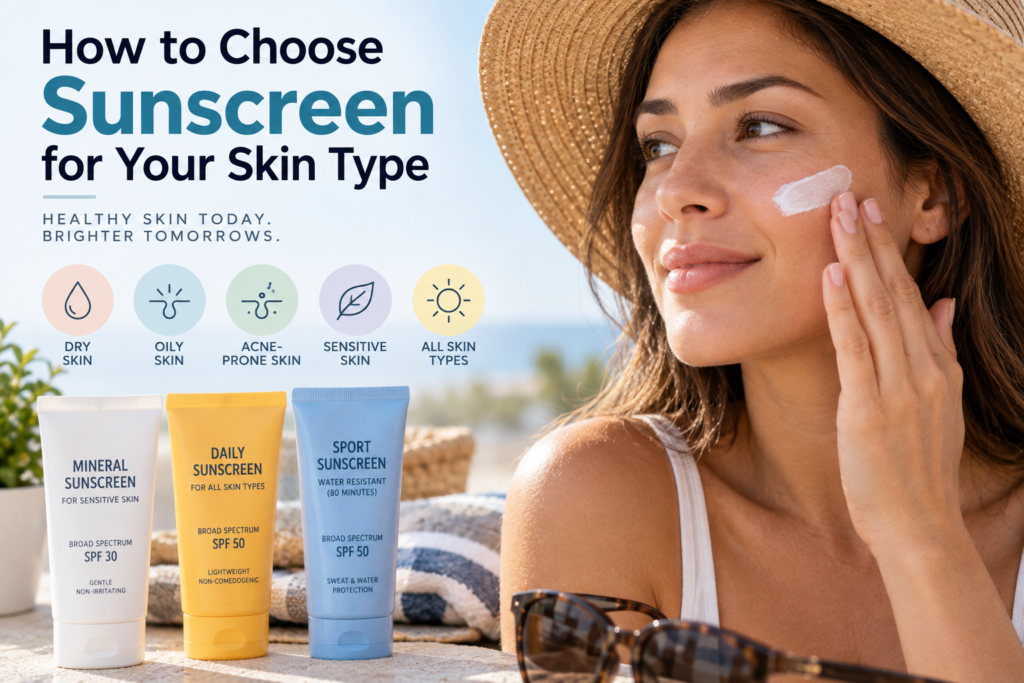
Sunscreen is one of the simplest daily habits for protecting your skin, but choosing the right one can feel confusing. There are mineral sunscreens, chemical sunscreens, tinted formulas, gels, sprays, creams, sticks, body lotions, face products, sport formulas, baby sunscreens, acne-safe options, and products made for sensitive skin.
The best sunscreen is not just the one with the highest number on the bottle. It is the one that gives you reliable protection and fits your skin type well enough that you will actually use it consistently.
The American Academy of Dermatology recommends choosing a sunscreen that is broad-spectrum, water-resistant, and SPF 30 or higher. Broad-spectrum means the product helps protect against both UVA and UVB rays, while water resistance matters when sweating or swimming. AAD sunscreen guidance is a useful starting point for anyone trying to compare labels.
From there, your skin type, daily routine, activities, and concerns can help you choose a formula that feels comfortable and works for your needs.
Start With the Three Basics
Before thinking about skin type, every sunscreen should meet three basic standards: broad-spectrum protection, SPF 30 or higher, and water resistance if you will sweat or swim.
SPF mainly refers to protection from UVB rays, which are strongly linked to sunburn. Broad-spectrum labeling means the sunscreen also protects against UVA rays, which contribute to skin aging and can also play a role in skin cancer risk. The FDA explains that broad-spectrum sunscreens provide protection against both UVA and UVB radiation. FDA sunscreen guidance also notes that water-resistant products must state whether they remain effective for 40 or 80 minutes while swimming or sweating.
No sunscreen is waterproof. If you are swimming, sweating, or outdoors for a long time, reapplication matters.
If You Have Dry Skin
Dry skin often does better with a cream or lotion sunscreen that includes moisturizing ingredients. Lightweight gels or alcohol-heavy formulas may feel drying or tight, especially on the face.
Look for labels that mention hydration, moisturizing, ceramides, glycerin, hyaluronic acid, or barrier support. A face sunscreen with moisturizing ingredients may be easier to use daily under makeup or on its own.
If your skin is very dry, apply moisturizer first, let it absorb, and then apply sunscreen. Some people can use a moisturizing sunscreen as both steps, but if your skin still feels tight or flaky, a separate moisturizer may help.
Dry skin can also be more sensitive to fragrance or strong active ingredients, so a gentle, fragrance-free formula may be more comfortable.
If You Have Oily Skin
Oily skin may need a sunscreen that feels lightweight and does not leave the face greasy. Look for terms like oil-free, matte, gel, fluid, lightweight, or non-comedogenic.
Some people with oily skin avoid sunscreen because they worry it will feel heavy or shiny. The right texture can make a big difference. Gel-based, water-based, or matte-finish sunscreens may feel more comfortable than thick creams.
If you wear makeup, a matte sunscreen can also help reduce shine throughout the day. However, do not rely only on makeup with SPF unless you are applying enough product to get proper coverage, which most people do not. A dedicated sunscreen underneath is usually more reliable.
If You Have Acne-Prone Skin
Acne-prone skin needs sun protection too. In fact, sunscreen can be especially important if you are using acne treatments that make your skin more sun-sensitive. Sun exposure may also darken post-acne marks, especially in people prone to hyperpigmentation.
The AAD recommends that people with acne-prone skin look for sunscreens labeled “non-comedogenic” or “won’t clog pores.” AAD guidance on choosing sunscreen also notes that different skin concerns may benefit from different labels.
For acne-prone skin, lighter textures often work better. Consider oil-free lotions, gels, or fluids. Mineral sunscreens may work well for some people, while others prefer chemical formulas because they are less visible or lighter on the skin.
If a sunscreen breaks you out, it does not mean all sunscreens will. It may mean that specific formula is not a good match. Try a product made for acne-prone or sensitive skin and introduce one new product at a time.
If You Have Sensitive Skin
Sensitive skin may react to fragrance, preservatives, certain chemical filters, alcohol, or other ingredients. If your skin stings, burns, flushes, or develops irritation easily, choose a sunscreen labeled for sensitive skin and consider fragrance-free options.
The AAD notes that dermatologists often recommend physical, or mineral, sunscreens for people with sensitive skin. Mineral sunscreens usually contain zinc oxide, titanium dioxide, or both. These ingredients sit on the skin’s surface and help block or scatter UV radiation.
Mineral formulas can sometimes leave a white cast, especially on deeper skin tones. Tinted mineral sunscreens may be a better option if you want sensitive-skin support with a more natural finish.
If you have a history of skin allergies, eczema, rosacea, or frequent irritation, test a small amount on the jawline or inner arm before applying it all over your face.
The Clinic Corner’s article on how to choose a safe and reputable med spa is also relevant because sensitive skin should be discussed before any cosmetic or skin treatment.
If You Have Darker Skin or Hyperpigmentation
People with darker skin tones still need sunscreen. While higher melanin levels provide some natural protection, they do not prevent sun damage, hyperpigmentation, or skin cancer.
One common concern is white cast. Some sunscreens, especially untinted mineral formulas, may leave a gray or chalky look on darker skin. Sheer chemical sunscreens, hybrid formulas, or tinted mineral sunscreens may blend better.
Tinted sunscreen can also be helpful for people with dark spots, melasma, or post-inflammatory hyperpigmentation. The AAD notes that visible light from the sun can worsen dark spots, and tinted sunscreens with iron oxides may help protect against visible light-related pigmentation concerns. AAD sunscreen FAQs provide more context on tinted sunscreen and hyperpigmentation.
If you are using treatments for dark spots, acne scars, melasma, or uneven tone, sunscreen is often essential. Without consistent sun protection, discoloration can be harder to improve.
If You Have Rosacea or Redness-Prone Skin
Rosacea-prone or redness-prone skin may be sensitive to heat, sun, fragrance, and irritating ingredients. Sunscreen is important because sunlight can trigger flushing for some people, but the wrong formula may sting.
Mineral sunscreens are often a good starting point for redness-prone skin. Look for fragrance-free, sensitive-skin, and gentle labels. Tinted mineral sunscreens may also help visually reduce redness while offering UV protection.
Avoid testing several new products at once. If your skin reacts easily, introduce sunscreen slowly and patch test first. If a product burns around the eyes or cheeks, try a different texture or formula.
If you are planning a skin procedure, talk with your provider about which sunscreen is appropriate before and after treatment. The Clinic Corner’s article on what to ask before trying laser or light-based skin treatments explains why skin type and treatment history matter before cosmetic procedures.
If You Have Mature Skin
For mature skin, sunscreen can help protect against further sun damage, uneven tone, fine lines, and texture changes. The goal is not only avoiding sunburn. It is also protecting the skin from cumulative exposure.
Creamier formulas may feel better on mature or drier skin. Some sunscreens include antioxidants, hydrating ingredients, or a dewy finish. Tinted options can also help even the look of skin tone without needing heavy makeup.
The most important factor is comfort and consistency. A sunscreen that pills under makeup, stings the eyes, or feels heavy is less likely to become a daily habit.
The Clinic Corner’s article on what is skin tightening and how does it work may be useful for readers thinking about skin aging and cosmetic treatments, but sunscreen remains one of the most important everyday steps for protecting skin from UV-related damage.
If You Are Choosing Sunscreen for Kids
Children need sun protection, but sunscreen choice should be age-appropriate. Babies under 6 months should generally be kept out of direct sun when possible and protected with shade, hats, and clothing. For older babies and children, sunscreen may be used as part of a broader sun-protection plan.
Mineral sunscreens are often popular for children and sensitive skin because they are less likely to sting. Look for broad-spectrum, SPF 30 or higher, water-resistant products. Sticks can be useful for faces, while lotions may be easier for full-body coverage.
For children, application matters just as much as the label. Reapply after swimming, sweating, or towel drying, and use protective clothing, hats, and shade whenever possible.
If You Spend Time Outdoors or Exercise
If you run, hike, swim, work outside, play sports, or spend long periods in the sun, choose a water-resistant sunscreen. The FDA requires water-resistant sunscreens to state whether they maintain protection for 40 or 80 minutes while swimming or sweating.
For outdoor activity, gels, sticks, sprays, and sport formulas may be more convenient. However, sprays must be applied carefully. Many people under-apply spray sunscreen or miss spots. Spray it until the skin glistens, then rub it in for even coverage. Avoid inhaling spray sunscreen, and do not spray it directly on the face.
Reapply at least every two hours and sooner after swimming, sweating heavily, or towel drying. Sunscreen should be paired with hats, sunglasses, UPF clothing, and shade when possible.
If You Wear Makeup
If you wear makeup, choose a sunscreen that layers well. Lightweight fluids, gel creams, and primer-like formulas may work better under foundation. Tinted sunscreens can sometimes replace a light base product.
Powder SPF and setting sprays can be useful for touch-ups, but they should not be the only sunscreen layer. It is difficult to apply enough powder to get full SPF protection. Start with a proper layer of sunscreen underneath makeup, then use SPF touch-up products later if needed.
If your sunscreen pills, try using less skincare underneath, allowing each layer to dry, or switching to a formula that works better with your routine.
Mineral vs. Chemical Sunscreen
Mineral sunscreens use active ingredients such as zinc oxide and titanium dioxide. Chemical sunscreens use organic UV filters that absorb UV radiation and convert it into heat. Both types can be effective when used correctly and labeled broad-spectrum.
Mineral sunscreens may be better tolerated by sensitive skin but can leave a white cast. Chemical sunscreens may feel lighter and blend more easily but can sting some sensitive skin types.
There is no single best choice for everyone. The best sunscreen is the one that provides appropriate protection and feels good enough for regular use.
How Much Sunscreen Should You Use?
Many people use too little sunscreen. The AAD recommends applying sunscreen generously to all skin not covered by clothing and reapplying every two hours or after swimming or sweating. AAD application guidance also recommends applying sunscreen before going outdoors so it has time to work.
For the face and neck, many dermatologists suggest using about two finger lengths of product, though exact amounts vary by product and face size. For the body, adults often need about one ounce, or enough to fill a shot glass, to cover exposed skin.
Do not forget ears, neck, chest, hands, tops of feet, hairline, and lips. Use a lip balm with SPF for lip protection.
Sunscreen Is Only One Part of Sun Protection
Sunscreen is important, but it should not be your only form of protection. Shade, wide-brimmed hats, sunglasses, protective clothing, and avoiding peak sun hours can all reduce UV exposure.
The FDA recommends broad-spectrum sunscreen, protective clothing, hats, sunglasses, and limiting time in the sun, especially around midday when UV exposure is strongest. FDA sun safety guidance is a helpful resource for practical sun protection habits.
This matters for every skin tone and every age group. Sun damage is cumulative, and daily protection is easier than trying to correct damage later.
When to Ask a Dermatology Provider
If you have a history of skin cancer, melasma, rosacea, eczema, acne, medication-related sun sensitivity, recent cosmetic procedures, or frequent irritation from sunscreen, ask a dermatology provider for guidance.
You should also ask for help if you notice a changing mole, new growth, bleeding spot, non-healing sore, or skin change that concerns you. Sunscreen helps reduce risk, but it does not replace skin checks.
The Clinic Corner’s article on how to choose the right spa treatment for your skin type is a helpful reminder that skin type, history, and goals should guide treatment decisions.
Final Thoughts
Choosing sunscreen for your skin type does not have to be complicated. Start with the essentials: broad-spectrum protection, SPF 30 or higher, and water resistance when swimming or sweating. Then choose a texture and formula that fits your skin.
Dry skin may prefer creams. Oily or acne-prone skin may prefer oil-free, non-comedogenic gels or fluids. Sensitive or redness-prone skin may do better with mineral sunscreen. Darker skin tones or hyperpigmentation concerns may benefit from sheer or tinted formulas. Outdoor activity calls for water-resistant products and consistent reapplication.
The right sunscreen is the one you will use every day. When sunscreen fits your skin, your routine, and your lifestyle, it becomes much easier to protect your skin consistently.