
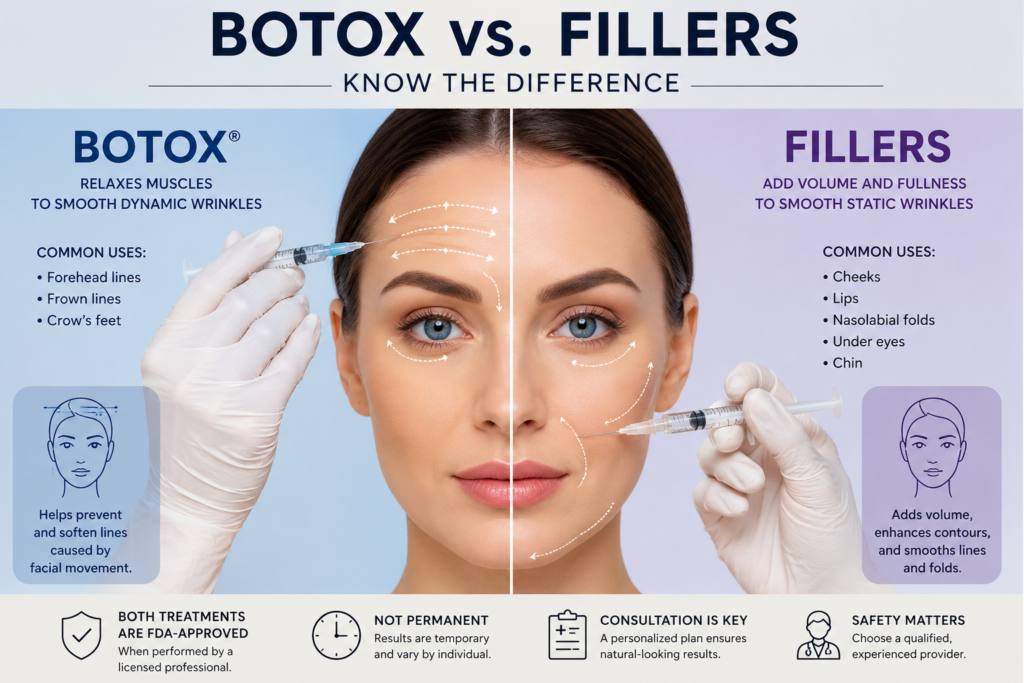
Botox and dermal fillers are two of the most talked-about cosmetic treatments, but they are also two of the most misunderstood. Many people use the terms interchangeably, assume both treatments do the same thing, or believe outdated myths about how injectables work.
The truth is that Botox and fillers are different treatments with different purposes. Botox is a brand name for one botulinum toxin product, often used cosmetically to temporarily reduce the appearance of certain facial lines caused by muscle movement. The CDC explains that people commonly use “Botox” as a general name for botulinum toxin products and procedures, although Botox is a registered trademark and was the first FDA-approved cosmetic botulinum toxin product.
Dermal fillers are different. The FDA describes dermal fillers as medical device implants injected under the skin to help create a smoother or fuller appearance in areas such as the cheeks, chin, lips, nasolabial folds, and backs of the hands.
Because these treatments are so common, myths spread quickly. Understanding what is true and what is not can help patients have safer, more informed conversations with qualified providers.
Myth 1: Botox and Fillers Are the Same Thing
One of the biggest myths is that Botox and fillers are basically the same. They are both injectable cosmetic treatments, but they work in very different ways.
Botox and other botulinum toxin products affect muscle activity. They are commonly used for lines that form from repeated facial movement, such as frown lines, forehead lines, and crow’s feet. Fillers, on the other hand, add volume or structure under the skin. They may be used to soften certain folds, enhance lips, restore cheek volume, improve facial balance, or address hollow-looking areas.
A simple way to think about it is this: Botox relaxes movement-related lines, while fillers restore or add volume. That is an oversimplification, but it helps explain the difference.
Some patients may benefit from one treatment. Others may benefit from both. The right choice depends on the concern, facial anatomy, health history, and the provider’s evaluation.
Myth 2: Botox Will Freeze Your Face
Many people worry that Botox will make them look stiff, frozen, or expressionless. This can happen if too much product is used, if placement is not appropriate, or if the injector does not understand facial anatomy well. But that is not the goal of properly performed treatment.
The goal is usually to soften the appearance of certain expression lines while preserving natural movement. A skilled provider should evaluate how your face moves before recommending where to inject and how much product to use.
A conservative approach is often best, especially for first-time patients. You can usually add more at a follow-up if needed, but you cannot instantly remove the effect once it has taken hold. Botox and similar products are temporary, but it still takes time for the effect to wear off.
This is why choosing an experienced, licensed provider matters.
Myth 3: Fillers Always Look Puffy or Fake
Another common myth is that fillers always make people look overdone. In reality, filler results depend heavily on the product used, the amount placed, the area treated, the patient’s anatomy, and the provider’s technique.
Poorly planned filler can look puffy, heavy, uneven, or unnatural. But subtle filler treatment may simply restore balance or volume that has changed over time. Many people with filler do not look obviously “filled.” They may just look a little more rested or balanced.
The key is moderation and proper placement. More filler is not always better. In some cases, a patient may not need filler at all. Loose skin, muscle movement, pigmentation, or texture concerns may require a different approach.
A qualified provider should be willing to say no if filler is not the right option.
Myth 4: Injectables Are Only for Older Patients
Botox and fillers are not limited to one age group. Some patients consider injectables in their 20s or 30s, while others begin later. The reason for treatment matters more than age alone.
Younger patients may be interested in softening early expression lines, balancing facial features, or addressing volume differences. Older patients may be interested in age-related volume loss, deeper folds, or lines that have become more noticeable over time.
That said, not everyone needs injectables. Starting early is not automatically better. A good candidate is someone with a specific concern that matches the treatment, realistic expectations, and a clear understanding of risks and maintenance.
Age should not be the only deciding factor. Anatomy, goals, health history, and provider judgment all matter.
Myth 5: Botox and Fillers Are Permanent
Botox and most fillers are temporary. Botox results typically develop over several days and wear off gradually over time. Fillers usually last longer than Botox, but they are still not permanent in most cases. The exact timeline depends on the product, area treated, amount used, metabolism, facial movement, and individual response.
The Cleveland Clinic notes that dermal filler results typically appear right away and can last for months. Different fillers have different expected durations.
Some patients like that injectables are temporary because treatment can be adjusted over time. Others may not realize that maintenance is needed to keep results. If you are considering Botox or fillers, ask your provider how long results may last for the area being treated and what maintenance may look like.
Myth 6: Fillers Can Fix All Signs of Aging
Fillers can be useful for volume-related concerns, but they cannot fix everything. They do not remove excess skin, fully lift sagging tissue, correct all wrinkles, improve every texture concern, or replace surgical procedures.
For example, if someone has significant skin laxity along the jawline, filler may not be the best answer. Adding too much volume to compensate for sagging can make the face look heavy or unnatural. In that case, skin tightening, laser treatments, surgery, or another approach may be more appropriate.
Fillers can also be overused when the real issue is skin quality, sun damage, muscle movement, or bone structure. A good provider should evaluate the full face rather than simply filling every hollow or line.
Myth 7: Botox Can Fill Wrinkles
Botox does not “fill” wrinkles. It works by temporarily reducing muscle activity in targeted areas. That may soften lines caused by repeated movement, such as frown lines or forehead lines.
Fillers physically add volume under the skin. They can soften certain folds or restore fullness in areas where volume has been lost.
This distinction matters because choosing the wrong treatment can lead to disappointing results. A forehead line caused by muscle movement may respond differently than a fold caused by volume loss. A lip enhancement requires a different product and technique than a frown-line treatment.
The best treatment plan starts with identifying why the line, fold, or hollow exists.
Myth 8: Anyone Can Safely Inject Botox or Fillers
Injectables may look simple from the outside, but they are medical procedures that require training, anatomy knowledge, sterile technique, proper products, and the ability to manage complications.
The CDC’s safety guidance for botulinum toxin injections recommends getting injections only from licensed healthcare professionals who are trained to perform the procedure and using FDA-approved products from reliable sources. This is especially important because counterfeit and mishandled products have caused serious harm.
The CDC investigated harmful reactions linked to counterfeit or mishandled botulinum toxin injections, with reports involving people who received injections for cosmetic purposes. This reinforces why patients should avoid unlicensed providers, unusually cheap products, home injections, social media-sourced injectables, or treatments performed in unsafe settings.
For fillers, the American Society of Plastic Surgeons explains that patients should be informed about risks and possible complications before treatment. Even though severe complications are uncommon, they can happen.
Myth 9: Cheap Injectables Are a Good Deal
Everyone likes saving money, but unusually cheap injectables can be a red flag. Low pricing may reflect diluted product, counterfeit product, inexperienced injectors, unsafe settings, or lack of proper medical oversight.
This does not mean the most expensive provider is always the best. But cosmetic injections should not be chosen based on price alone. Patients should ask what product is being used, who is performing the injection, what training they have, whether the product is FDA-approved for the intended use, and how complications are handled.
If a deal sounds too good to be true, it may not be worth the risk. Your face, health, and safety matter more than a discount.
Myth 10: Filler Can Always Be Reversed
Some fillers can be dissolved, but not all fillers are easily reversible. Hyaluronic acid fillers are often considered more adjustable because they can sometimes be dissolved with an enzyme called hyaluronidase. However, dissolving filler is still a medical treatment and may require professional judgment.
Other filler types may not be dissolved the same way. Some are designed to stimulate collagen or provide longer-lasting structure, which can make correction more complex.
This is why it is important to know what kind of filler is being used before treatment. Ask your provider what product they recommend, why they recommend it, how long it may last, and what options exist if you do not like the result.
Myth 11: Botox and Fillers Have No Risks
Botox and fillers are common, but common does not mean risk-free. Botox may cause temporary bruising, swelling, headache, eyelid droop, uneven results, or unwanted muscle effects. Rare but serious effects can occur if toxin effects spread.
The FDA has required boxed warnings for botulinum toxin products related to the risk of toxin effects spreading from the injection site, which may cause symptoms such as swallowing or breathing problems in rare cases. The FDA’s botulinum toxin safety communication discusses these warnings for products including Botox, Dysport, and Myobloc.
Fillers may cause swelling, bruising, tenderness, lumps, asymmetry, infection, discoloration, and unsatisfactory results. Rare but serious complications can include vascular occlusion, tissue injury, vision problems, or scarring.
A safe provider should explain risks clearly before treatment. Patients should also know what symptoms require urgent follow-up.
Myth 12: You Should Look Exactly Like the Photo You Bring In
Reference photos can help communicate preferences, but they should not be treated as a guarantee. Every face is different. Bone structure, skin thickness, symmetry, age, proportions, movement, and existing volume all affect what is realistic.
Trying to copy someone else’s lips, cheeks, jawline, or facial shape can lead to results that do not fit your natural features. A good injector should use inspiration photos as a conversation starter, not a blueprint.
The best cosmetic treatment should fit your face. The goal is usually balance, proportion, and natural-looking improvement rather than copying someone else’s result.
Myth 13: More Product Means Better Results
More product does not always mean better results. With both Botox and fillers, the right amount matters. Too much Botox can reduce expression more than desired. Too much filler can create puffiness, heaviness, distortion, or an unnatural look.
A thoughtful provider may recommend starting conservatively, especially if you are new to injectables. They may suggest treating one area first, reassessing after results settle, and adjusting over time.
Good injectable work often requires restraint. The goal is not to use as much product as possible. The goal is to use the right product in the right place for the right reason.
Myth 14: You Can Go Anywhere for the Same Result
Injectable results are highly provider-dependent. Two providers can use the same product and get very different outcomes. Technique, anatomy knowledge, aesthetic judgment, safety training, consultation quality, and follow-up all matter.
Before choosing a provider, ask about credentials, experience, product selection, complication protocols, and before-and-after examples. Make sure the treatment setting is clean, professional, and appropriate for medical cosmetic care.
You should never feel rushed, pressured, or dismissed. A good consultation should include your goals, health history, risks, alternatives, and realistic expectations.
Final Thoughts
Botox and fillers can be helpful cosmetic tools when used appropriately, but myths can lead to confusion and unrealistic expectations. Botox and fillers are not the same. Botox does not fill wrinkles. Fillers cannot fix every sign of aging. Injectables are temporary, provider-dependent, and not risk-free.
The safest approach is to work with a licensed, trained professional who uses appropriate products, explains risks clearly, and creates a plan based on your anatomy and goals. Avoid bargain injections, unlicensed providers, counterfeit products, and unrealistic promises.
If you are considering Botox or fillers, schedule a consultation with a qualified provider. A good consultation can help you understand what each treatment can do, what it cannot do, and whether injectables are the right fit for you.